Collaboration: Increasing Your Success with Synergy

Collaboration where the goal is to create results where, “The whole is greater than the sum of its parts.” ~ Aristotle

How do companies create teams where team members produce greater results together than working separately? How do great leaders create powerful teams? Here are some ideas to help answer those questions.

Collaboration by Combining Different Skills and Different Experience

For the greatest power of synergy, surround yourself with people who know things that you don’t know.

Synergy is the process of combining the efforts of individuals or organizations to produce greater results together than the total combined results of working separately.

For example, let’s say that companies X, Y, and Z earn a total of $5 million working separately.  However, by merging their efforts, these three companies earn $10 million.

The efforts of the synergistic teams do more than add more hands working on the assembly line.  These teams add people who empower each other through the combination of their different skills and experience.

First-Hand Experience

There are multiple reasons why collaboration is so effective.  One of the reasons is that synergy fills in the gaps of knowledge among individuals or among individual organizations.

A simple example is my experience in teaming up with other recruiters to share work. Together, we each made more money by combining our resources than each of us would have made working alone.  I had recruiting contracts and job applicants.  The other firms had different recruiting contracts and different job applicants.

By working with each other, we could accelerate filling jobs by helping each other find job applicants for our recruiting contracts.

In most companies, departments work separately to do their jobs.  Sales planning does sales planning.  Marketing does marketing.  Manufacturing does manufacturing.

But some projects require knowledge from each of these departments.  Collaboration empowers teams from separate departments to produce greater results by filling in the knowledge gaps among the teams.

Collaborating with Specialists

A simple Case study:  Collaborating with specialists helps people focus on what they do best. Writers know how to write.  Some writers can do a reasonable job of editing their own work.  Also, most writers can figure out how to copyright their material.  However, writers can produce far more material by just writing and having experts handle the other tasks in publishing a book.

4 Essential Steps to a Highly Successful Career Change

Career Change:  Below are powerful tools and suggestions others have found helpful in making an effective career move.

4 Essential Steps to a Highly Successful Career Change

  • Resume
  • Resume Cover Letter
  • Interview Preparation
  • Thank You Letter

You don’t have to do everything for success. But you do have to do the right things. ~ www.jaywren.com

First, a Resume is Basic to a Career Change

Here is what you put into a resume and the order in which you put this information.  If you replace this information with your information, you will have written a resume.

Your name
Street address
City, State Zip
Phone
Email address

Rule 1: Never refer to yourself in the third person in the body of the resume.
Rule 2: Use factual accomplishments and not subjective opinions of yourself.

  • Example of a fact:  exceeded assigned sales goal by 30%
  • Examples of opinion; goal-oriented, creative, tenacious, strategic, honest, loyal:  For a person to
    use adjectives about themselves puts human resource people to sleep

Objective:  This is optional and often redundant.  Your resume has the objective of getting you interviews with an employer who sees a match in your location, your compensation, and your experience and that employer’s needs.  It is conventional to state an objective here but you can probably find a better use for the space.

Employment History (Most recent job first)

Company Name, Location, and Period of Employment (From to)
Most recent title:

  • Use bullet format.
  • List things you have accomplished.
  • Do not waste space on your just giving a job description.
  • List things that showed you made a difference.
  • Include increasing sales, reducing costs, promoting people, saving time, increasing productivity,
    etc.
  • Employers and recruiters search their databases for specific words.
  • List successes with specific industry words or functions.
  • Include the actual name of your product categories, product names, sales accounts, functions (e. g, Profit & Loss, Market Research or Software Names, New Product Development, Market Insights, Innovation), etc.

Next List Previous Titles at this company and again bullets on successes:

  • List your accomplishments.
  • Do not waste space on your just giving a job description.
  • List things that showed you made a difference.
  • Things you have accomplished include increasing sales, reducing costs, promoting people, saving time, increasing productivity, etc.
  • Companies and recruiters search their databases for specific words.
  • Include the actual name of your product categories, product names, sales accounts, functions (e.g., Profit & Loss, Market Research or Software Names, New Product Development, Market Insights, Innovation), etc.

Then include Previous Companies going back in time from most recent.

Education goes next after you have listed the first job you held after college or in your career:  Part-time or vacation jobs held while in school are sometimes not listed except as a bullet to the education experience.

Do not put references or salary information on your resume.

Second, Resume Cover Letter

Suggestions on writing a cover letter

Your Name
Street Address
City, State Zip
Phone Number
Email Address

Date

Name of person receiving your letter
Company Name
Street Address
City, State Zip

Dear First Name:

(If you come recommended by someone, list that person’s name here).  Name of person referred me to you.  I am writing to apply for as position as a (fill in name of position) with your company.  My resume is attached.

In my resume, you will find a record of success in (list competencies)

When may I interview with you?

Best regards,
Your Name

Third, Interview preparation

Here is what you can do to have a better interview.

1) Prepare an agenda for the interview, things you want to cover.
2) Research the company.  Find articles on the company and use information from these articles in your interview presentation.
3) Research the job and be prepared to talk about how your skills fit the job.
4) Review your skills and the information in your resume.
5) Be upbeat and positive about the world, the way you might be on a Friday afternoon.
6) Take with you extra copies of your resume, a typed list of questions, and paper and pen for notes.
7) Bring examples of your work that show your skills and successes.
8) Be factual about the work you did and the work others did to make you a success.
9) In the interview, listen to the questions you are asked and be sure that you understand the question before answering.  If the question is too broad to enable you to give a good answer, ask the interviewing to help you understand better what he or she is trying to learn.
10) Be positive when you talk about your current company, your boss, and your job.  Emphasize that you are looking to make a change to get more of what the company interviewing you has to offer.
11) Write stories of your successes as preparation to discuss how you can contribute to a company’s business.

Outline for an Interview Agenda

Candidates have found that the following outline is effective in getting the job.

In using this type of outline to prepare for an interview, a person will have anticipated and practiced how
to handle many of the questions and contingencies that may arise in a job interview.

WHY I AM INTERESTED IN WORKING FOR YOUR COMPANY

WHAT I BRING TO A COMPANY IN YOUR INDUSTRY

MY PLANS FOR DEVELOPING YOUR BUSINESS

WAYS THAT I CAN ENSURE THAT THIS HAPPENS

WHY I AM INTERESTED IN WORKING FOR YOUR COMPANY

  •        The reputation of the company
  •        The long history of success of the company
  •        The appeal of the industry
  •        The opportunity to work in an environment that enables me to use my skills
  •        The company commitment to respecting and honoring their employees with programs
  •        The opportunity to work in the field of my choice

WHAT I BRING TO A THIS INDUSTRY

  •        Creatively and enthusiastically use the knowledge I gained in college to make the organization
    more successful
  •        Have a range of appropriate skills
  •        Have developed marketing strategies to include customer service, pricing, and product selection

Fourth, Thank You Letter

Your name
Street address
City, State Zip
Phone
Email address

Date

Mr. /Ms. Interviewer
Name of company
Street address, City, State Zip

Dear Mr. /Ms. Interviewer:

Thank the person for meeting with you.

Express your impression of the company.

Express your interest in the job.

Best regards,

Your name

Extra Tools and Tips Summary

  1. Reference material
  2.  Work your network by making a list of every possible contact you have ever made in business and contact these people for ideas and opportunities.
  3. Ask for referrals of every person you contact.
  4. Lay out your goals as specifically as you can, but be aware that the more flexible you are in terms of money, location, and opportunity the more opportunities you will have available to you.
  5. Contingency recruiter or retained recruiter?  In practice, how a recruiter is compensated is not nearly as important as what contacts the recruiter has.  Typically, retained recruiters are conducting searches where the salary is above $750,000 and involve “C” level managers.
  6. Be organized.  Make a list daily of your contacts, what you discussed what action you have taken and what action needs to be taken.
  7. Read the want ads in the local newspaper, national publications, and especially trade journals. Become an expert on what is in the job market.
  8. Before approaching a company directly, research it thoroughly.  How is it structured?  Bottler, distributor, direct, or broker sales?  Public or private?  Do you have a referral to get your foot in the door, etc.?  Who are the key managers for the job you are seeking? To whom do these people report?
  9. Prepare for an interview the same way you would prepare for a major sales call, business review, or planning session where you are the key presenter.
  10. Follow up on contacts you have made.
Quit Struggling to Get Jobs Below Your Qualifications

Qualifications: Quit Struggling to Get Jobs Below Your Qualifications. Are you frustrated, because hiring companies will not see you for jobs you can do easily?  Are you overqualified for these jobs.  There risks to you and the employer in hiring people who are overqualified.

Risks to Employers

Speaking as a recruiter, I can tell you that my clients focus on specific skills.  These clients want to hire qualified candidates. However, they avoid overqualified applicants.

Why? Overqualified people are a risk of leaving as soon as they find a job at their skill level.   Vacancies are a burden.  They damage morale and productivity.  Filling vacancies takes time away from other company efforts. Furthermore, staffing fees are costly, especially when searching for highly qualified candidates.

The Risks to You for Interviewing Job Below You Qualifications

Taking a job below your qualifications damages your career.  You risk creating a picture of yourself as backslider.  You raise questions about your ability to continue to grow.  Furthermore, you may raise questions about what happened to push you back in your career.

How to Get Great Interviews with Companies Who Need Your Experience

Case Study:

Bob (not the real name): “How I should format my resume for the greatest success?”

Me: “As a person with advanced degrees and advanced qualifications, you should consider two formats for you resume: A Curriculum Vitae (CV) format or a resume format. Here are two articles that may help.

Bob: ”How should I list my skills in a resume?”

Me: “Be specific. For example, I once had a search for a company that sold perishable products (products types are different from this example). I had a resume for a general manager who was perfect for the job. His resume showed that he had canned goods experience.  However, his resume did not show is that he also had the required perishable foods experience at the same company.

After I filled the job, I learned that he was qualified for the job.

Bob: “How do I select companies?”

Me: “My recommendation is that you target specific jobs, not just every job opening. Identify roles that match your skills and get to know people who work at places that hire people for those roles.

Use your current close professional and personal network more frequently than you use a broad network of people on LinkedIn.

When introducing yourself via a referral, first ask for permission to use the person as a reference.

Where you have friends, who want to help you, ask them to forward your resume to a professional at a place where you want to work. Additionally, ask them to copy you on the resume.  Then you follow up directly with the new contact.”

Impact Writing: 4 Ways to Engage Your Reader

Impact writing: In a digital world, everyone is a writer. However, not everyone entered the digital world with the same writing skills. How can you engage your readers for action and interest?

4 Ways to Engage Your Reader with Impact Writing

  • Don’t Add the Word, “Very.”
  • Don’t write “Is, Was, and By.”
  • Use Words that Show Commitment.
  • Verify Your Quotes.

Don’t Add the Word, “Very.”

Adding the word “very” to a sentence makes it weaker.

There are three options to more impactful writing.

  1. Just cut the word “very.”
  2. Create a comparison for impact.
  3. Use stronger wording.

For example:

Weak: “Susan is very intelligent.”
Comparison: “Susan is more intelligent than her friends.”
A stronger statement: “Susan is brilliant.”

A second example:

Weak: “Bill ran very quickly across the yard.”
Better: Bill ran quickly across the yard.
Stronger wording: “Bill sprinted across the yard.”

Don’t Write “Is, Was, and By”

These three words create longer, weaker sentences.

Weak: “This play was written by Shakespeare. ”
Stronger: “Shakespeare wrote this play.”

Notice that the first sentence is longer.  It has two more words than the second sentence.  The extra words weaken the sentence.  Additionally, effective sentences show action.  They start with the person, place, or thing that acted.

Weak: “The city was flooded by the storm.”
Stronger: “The storm flooded the city.”

Use Words that Show Commitment

Weak: “When I get to it”
Stronger: “I will finish it and have it back to you at 3:00PM.”

Weak: “Maybe I’ll work on it later.”
Better: “I will start on this project at 8:00AM and have it back to you by 11:00AM.”

Verify Your Quotes.

For example, Mark Twain didn’t say,

“If you don’t read the newspaper you are uninformed; if you do read the newspaper you are misinformed.”

Winston Churchill didn’t say,

“If you’re going through hell, keep going.”

Abraham Lincoln didn’t say,

“You can fool all the people some of the time and some of the people all the time, but you cannot fool all the people all the time.”

You can do a web search to verify quotes. I start with sentence like this, “Benjamin Franklin didn’t say…”

For example, you can search the Internet for “Benjamin Franklin didn’t say a penny saved is a penny earned.”

Published
Categorized as Leadership

Top Trending Jobs by Title

Account Executive
Account Manager
Accountant
Actuary
Administrative Assistant
Analyst
Applications Engineer
Art Director
Assistant Manager
Assistant Store Manager
Assistant Vice President
Associate Director
Attorney
Auditor
Branch Manager
Business Analyst
Business Development Manager
Cashier
Civil Engineer
Consultant
Customer Service Representative
Data Analyst
Design Engineer
Developer
Director
Doctor
Electrical Engineer
Engineer
Executive Assistant
Finance Manager
Financial Manager
Financial Analyst
Flight Attendant
General Manager
Graphic Designer
Hardware Engineer
Human Resources
Investment Banker
IT Analyst
IT Manager
IT Specialist
Java Developer
Law Clerk
Manager
Marketing Director
Marketing Manager
Mechanical Engineer
Network Engineer
Nurse
Office Manager
Operations Analyst
Operations Manager
Pharmacist
Software Engineer
Process Engineer
Product Manager
Program Manager
Programmer
Programmer Analyst
Project Engineer
Project Manager
QA Engineer
Recruiter
Registered Nurse
Research Assistant
Research Analyst
Research Associate
Sales
Sales Associate
Sales Engineer
Sales Manager
Sales Representative
Surgeon
Software Engineer
Systems Engineer
Technical Staff
Web Developer
Find More Jobs

Time Management: Building the Skills for Staying on Task

Time Management: Success comes from getting things done. Successful people use their time effectively to accomplish more. ~ www.jaywren.com

Big Projects and Time Management

When going through lengthy periods with big projects, I sometimes forget to set a daily schedule.  Deadlines come at me quickly. The most pressing tasks take priority over everything else.

But not keeping a schedule on busy days is a mistake.  I overlook small things that are still critical to overall success.  Furthermore, I let the demands of a big project become a flurry of activity that can take me off daily tasks that are critical to the project.

Returning to Time Management

When I stop keeping a schedule, my days become less productive. I wander off task.

I check my email.  Then, I check online for messages.  Next, I click around a couple of websites to stimulate my thinking for new projects.  Even though I have been very busy, I accomplish little or nothing.

Daily Schedule: Activities with Objectives

I schedule an activity.  Then I add what I plan to accomplish. I learned this lesson at Procter & Gamble.  I not only scheduled my sales appointments.  I list what I must accomplish during those appointments.

Scheduling an activity and a list of objectives is effective with personal matters.  For example, I have a doctor’s appointment on my schedule. I add the things I need to discuss with the doctor during my visit. My visit is more effective as I cover all the tasks I have for the doctor.
For me, there are several benefits to including objectives to my list of things to do.

  1. I don’t overlook important issue.
  2. Stating objectives is stimulates creativity.  I awaken my mind to more opportunities.
  3. Each day, I accomplish more.  Over the years, these accomplishments create greater success.
  4. I do one thing at a time.

Status Board 

As I complete tasks, I mark them completed.  At the end of the day, I review the schedule for tasks to reschedule.

My schedule is a status board of tasks done and not done.  I know which tasks I can put out of my mind.  Furthermore, I have the confidence of knowing that I will continue to stay on tasks the following day.

Character: Four Leadership Traits for Long-Term Success

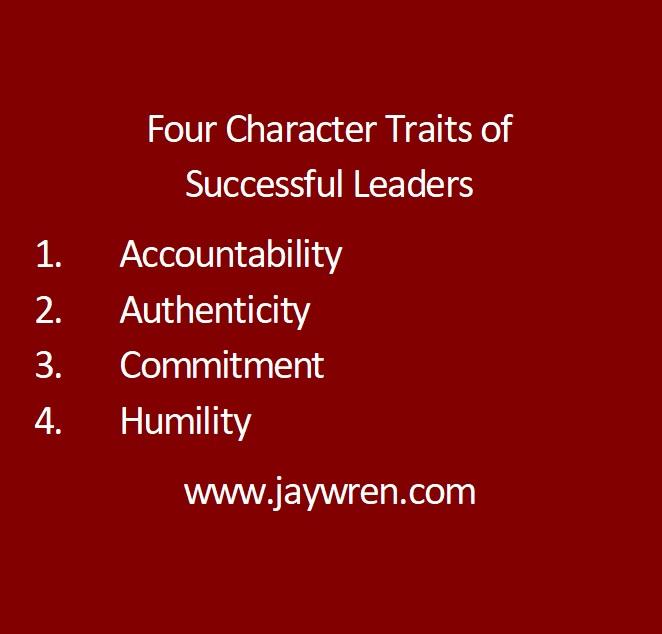
Character traits for leadership are more than a leader’s personality.  These traits are a leaders’ moral, emotional, and mental makeup.  What character traits empower leaders to excel?

Leadership Character Traits

They are many character traits that make leaders successful.  Here are four of those traits.

  1. Accountability
  2. Authenticity
  3. Commitment
  4. Humility

Accountability

President Harry Truman said, “The buck stops here.”

Leaders hold themselves accountable.  I was a lieutenant in the United States Navy.  My commanding officer (that is, my captain) held me accountable for my actions.  Additionally, the Navy also held my captain accountable.

Successful leaders accept accountability for the failure of their organization.  These leaders can’t do everyone’s job.  However, they can build and train an organization for success.

At the end of the football season, the fans may blame the quarterback for the failures of a team.  However, a head coach with the authority to lead is accountable for the team’s results.

That coach can try to place the blame on the players.  But the coach is the person who hired and trained those players.  The coach is the one who is accountable.  Therefore, successful leaders must hold themselves accountable.

Authenticity

By playing politics, you may be able to gain support from people above you and around the office.  However, if you focus on politics and not performance, you will fail in the long-term.

Furthermore, authenticity is the bedrock of innovation.  When you focus on pleasing people instead of better ways to help you company, your creativity dies.

“If you copy other people, you are an impersonator. When you remake the work of other people in ways that it becomes your own work, you are authentic. When authenticity leads you to break the rules and change the world, you are a rebel. With authenticity, rebels change the world.
~ www.jaywren.com”

Commitment

The failed expectations of others undermine leadership as much as any other event.

Failing to fulfill your commitments weakens the trust that people have in you.

To be more effective, do these things in honoring your commitments.

  • Act Now.
  • Exceed Expectations.
  • Arrival early.
  • Work through the finish of the day.
  • Be honest about your abilities.
  • Don’t over commit in the first place.

Humility

The best book I have read on humility as a leadership trait is Good to Great: Why Some Companies Make the Leap and Others Don’t by Jim Collins.

If you personalize to your own experience, how much do you enjoy having other people take part or all of the credit for your efforts?  The people you lead are no different.

Great leaders have the humility to give credit to the team. To quote President Reagan, “There is no limit to the amount of good you can do if you don’t care who gets the credit.”

Published
Categorized as Leadership

New Year Success: Personal Steps to Powering Up 2018

New Year Success: The new year is a great time to reset routines.  Here are things that I am doing to make this year fun and productive.

  • Plan play time
  • Spend Time with Supportive People
  • Meet New People and Make New Friends
  • Spend Twenty Minutes for Quiet Time
  • Forgive My Enemies

New Year Success

Do more than make resolutions to lose weight, exercise, and work harder for New Year Success.

Do things that will make you happier and emotionally stronger. Empower your new year success with greater physical and mental health.

Plan Play Time

Before scheduling anything else on your calendar, schedule time for recreation.  Certainly, plan recreational things to do on your days off.

Furthermore, schedule recreation for the middle of the work week.  Sports activities are excellent ways to relieve stress and have fun during work week. A few holes of golf.  Basketball, softball, baseball, golf.  Something you enjoy and that helps you relieve stress and relieve emotional kinks.

Including your friends in these activities reinforces your commitment.

Spend Time with Supportive People

Good company does more than make life fun.  Family members and friends who encourage you build your confidence.  Furthermore, these people can help you find solutions and succeed in difficult times.

Meet New People and Make New Friends

Go places where you can make friends with people who share your interests.  Health club. places of worship. business conferences, and meetups are some places where you can meet new people.

Furthermore, meeting and connecting with new people helps you extend your network and discover new ideas for success.

Twenty Minutes of Quiet Time

Take twenty minutes a day to rest and clear my mind.  Rest your eyes. Meditate. Pray. Take a nap. Take a walk.

Set a time that works with your schedule.  That is, first thing in the morning, during the work day, or after work.

Find a place where you can sit quietly.  Close your eyes and relax.

Practice Forgiveness

Anger and resentments rob us of peace and gratitude for the rewards in our life.

Holding on to anger and resentments builds tension and drains our energy.

Letting go of these feelings helps us return to the present moment and enjoy life more.

Creating Future Leaders: 4 Steps to Leadership Development

Creating Future Leaders:  How can companies hire and train future leaders? Here are four steps companies can take to strengthen their leadership for the long term.

The Four Steps to Creating Future Leaders

Creating future leaders is critical to the long-term growth of a company.  ~ www.jaywren.com

  1. Hire for leadership
  2. Establish Authority & Responsibility
  3. Teach for leadership
  4. Increase Responsibility

Hire for Leadership

People in any organizations have specific levels of responsibility.  Some of those people will stay in same job for which the company hires them.

Other people come into a company as developmental candidates.  These people may start in entry-level jobs.  However, the company has a plan to move these people into bigger roles.  Their responsibilities increase as they master each job.

Teach Authority, Responsibility, and Accountability

For new leaders to become successful, they must know their authority.

They must know what they can do.  Additionally, they must know when to notify their supervisors.

Furthermore, they must know their responsibilities.  Knowing the boundaries of their responsibilities makes them more engaged and focused.

Last, future leaders must learn accountability.  They are not only accountability for their own mistakes.  They are accountable for the mistakes of the people under them.

Accountability is a great teacher. ~ www.jaywren.com

Train for Leadership

Authoritative leaders criticize. They control the people who work for them.

Ordering people around teaches them the things what not to do.

However, future leaders must learn more than what not to do.  Mentoring leadership builds confidence and skills in future leaders.  Without this mentoring, a company is not creating future leaders.  It is creating people who follow orders.

Increase Responsibility

For leaders to continue to grow, their responsibility must increase.  Companies promote new leaders into bigger positions.  These positions have a higher pay grade.  Additionally, they have the greater responsibility.

However, companies cannot always promote leaders. But they must keep the leaders growing and engaged.

What companies can do is relieve experienced future leaders of bottom rung responsibilities.  At the same time, companies can give them responsibilities that will prepare them for greater responsibility.

Published
Categorized as Leadership

Open-Ended Questions: Solving Problems and Creating Leadership

Open-Ended Questions: What are they? How do they create opportunities for greater understanding in solving problems and creating leadership?

One of the most important skills in leadership is the ability to answer open-ended questions. ~ www.jaywren.com

Examples of Open-Ended Questions

Open-ended questions enable a person to give meaningful, well-developed answers.  The person uses knowledge, feelings, creativity, and skills of self-expression.

Furthermore, these questions show how well a person can think . That is, to see not just one solution, but multiple solutions.

Examples:

“What are business problems that you have solved? How did you solve them?”

“What would you do if you never had to work again?”

“Why should I hire you?”

Examples of Closed-End Questions

People use convergent thinking to answer closed-end questions. Additionally, closed-end questions have one answer.

“What color is your car?”
“Blue.”

“How many fish in the bowl?”
“Three.”

“Did you leave at 4:30?”
“Yes.”

The Importance of Developing Skills for Open-Ended Questions

Some brilliant people have very poor skills for answering open-ended questions. They have vast amounts of knowledge.  They know the facts and can solutions.

However, their careers falter, because they cannot express their knowledge and their ideas.

For example, financial executives must have skills to know the accuracy of their calculations.

CFOs must be able to explain to a board what the numbers mean.  Additionally, they must be able discuss how the company got into a financial position and how to manage the company’s finances going forward.

Presentation Skills

The place to start learning how to answer open-ended questions is presentation skills.  Developing these skills with help you do many things.

  • Sell more effectively,
  • Interview more effectively,
  • Become a more effective public speaker,
  • Be a leader in workplace meetings.

In short, you will be more successful when you develop your skills to answer open-ended questions.

In conclusion, here are articles that will help you become more effective in answering open-ended questions.

Published
Categorized as Leadership