Living in the Present Moment

Living in the Present Moment

Sometimes, people struggle with living in the present moment. They are either haunted by the past or worried about the future. They miss the beauty and joy of life as it unfolds in front of them. They are not fully aware of their thoughts, feelings, sensations, and surroundings. They are not mindful.

Mindfulness is the practice of paying attention to the present moment with curiosity and openness. It is a skill that people can learn and cultivate through various techniques, such as meditation, breathing exercises, yoga, and journaling. Mindfulness can help us live in the present moment more fully and intentionally.

Benefits

Why is living in the present moment important? There are benefits of being mindful and present. Here is a brief list of those benefits.

Living in the present moment can reduce stress and anxiety. When we are mindful, we are less likely to ruminate over the past or worry about the future. We can accept what is happening right now without judging it or resisting it. We can cope with challenges more effectively and calmly.

Living in the present moment can enhance our happiness and well-being. When we are mindful, we are more likely to notice and appreciate the positive aspects of our lives, such as our relationships, our achievements, our hobbies, and our health. We can also savor the pleasant experiences and emotions that we encounter in our daily lives.

Living in the present moment can improve our performance and productivity. When we are mindful, we are more focused and attentive to the task at hand. We can avoid distractions and procrastination. We can also be more creative and innovative, as we are open to innovative ideas and perspectives.

Living in the present moment can foster our growth and learning. When we are mindful, we are more curious and willing to explore new things. We can also learn from our mistakes and feedback, as we are not defensive or ashamed of them. We can embrace challenges and opportunities as ways to improve ourselves.

How can we live in the present moment more often? There is no one-size-fits-all answer to this question, as different people may find different methods more suitable for them. However, here are general tips that can help us become more mindful and present:

Steps to Becoming Mindful

Set aside time every day to practice mindfulness. This can be as simple as taking as focusing on your breath, or as elaborate as doing a guided meditation or a yoga session. The key is to be consistent and committed to your practice.

Incorporate mindfulness into your daily activities. You can practice mindfulness while doing anything, such as eating, walking, driving, and working. The key is to pay attention to what you are doing, feeling, thinking, and sensing in each moment.

Use reminders and cues to bring yourself back to the present moment. You can use anything that works for you, such as an alarm, a bracelet, a sticker, or a mantra. The key is to use them regularly and consciously to remind yourself to be mindful.

Be compassionate and gentle with yourself. You may not be able to live in the present moment all the time, and that’s okay. You may get distracted or forgetful sometimes, and that’s normal. The key is to acknowledge your lapses without judging or criticizing yourself, and then gently bring yourself back to the present moment.

Living in the present moment is not easy, but it is possible and rewarding. It can help us live happier, healthier, and more fulfilling lives. It can also help us make a positive difference in the world around us. So why not try it?

Photo by Sean Oulashin on Unsplash

Strengths and Weaknesses

Success comes more easily when you can play to your strengths.
Jay Wren

Strengths:

  • Self-awareness: You are aware of your strengths and weaknesses, and you are willing to work on improving them.
  • Problem-solving: You are able to identify and solve problems effectively.
  • Communication: You are able to communicate effectively, both verbally and in writing.
  • Teamwork: You are able to work effectively as part of a team.
  • Adaptability: You are able to adapt to new situations and challenges.

Weaknesses:

  • Procrastination: You may sometimes procrastinate on tasks.
  • Impulsiveness: You may sometimes act without thinking through the consequences.
  • Perfectionism: You may sometimes be too hard on yourself and set unrealistic expectations.
  • Indecision: You may sometimes have difficulty making decisions.
  • Overthinking: You may sometimes overthink things and get stuck in analysis paralysis.

It is important to note that these are just examples, and your own strengths and weaknesses may vary. The key is to be honest and authentic when discussing your strengths and weaknesses, and to focus on the areas where you are most confident and capable.

Here are some tips for answering the “strengths and weaknesses” question in a job interview:

  • Be specific. Don’t just say that you are a good communicator or a hard worker. Give specific examples of how you have demonstrated these qualities in the past.
  • Be positive. Focus on your strengths, and avoid dwelling on your weaknesses.
  • Be actionable. Discuss what you are doing to improve your weaknesses.
  • Be confident. Believe in yourself and your abilities.

Photo by Michael Dziedzic on Unsplash

Artificial Intelligence

The willingness of people to believe what they see on the Internet tells me that artificial intelligence may soon if not already be programming humans.

~ Jay Wren

Experts now believe that 42% of the information on the Internet comes from bots. Bots post human created content. Humans respond to content on a conscious level and an unconscious. At the unconscious level, our minds respond to content emotionally. The emotions are centered in our beliefs. We feel a range of emotions from neutral to very strong. Positive feelings draw us to or push away from the people, places, and things in our life. Writers, advertisers, politicians, and clergy use words to influence our thinking, reinforce our beliefs, and direct our actions.  Artificial intelligence can now create and publish content on the Internet.

Photo by Tom Barrett on Unsplash

Sweet Lies

With the Internet, the truth is right there, for everyone. At the same time, politicians and political influencers, more than ever, have normalized lying and people believe them. Why? Because a sweet lie is so delicious. 

Why do we lie to ourselves?

We may lie to ourselves to avoid painful truths, to boost our confidence, to persist in our goals, to create a favorable impression, or to support our beliefs.

Lying to ourselves can reduce stress and enhance our self esteem. It can make us feel safe in our beliefs. However, lying to ourselves distorts reality and impaires our judgment. Therefore, it is important to be aware of our willingness to see the world in a light that just makes us comfortable.

Photo by Isabela Drasovean on Unsplash

The Power of Smiling

Feeling Anxious? Try Smiling. ~www.jaywren.com

Is Anxiety Killing Your Career?

Anxiety can make you avoid opportunities for work, fun, and networking.  It can cut your opportunities for leadership roles.  Your anxiety can generate signals that make it harder for people to reach out to you.

Smile

There are many things that you can do to calm your jitters.  Perhaps the most overlooked way is simply to smile.  People smile when they are happy.  And equally important is that smiling can help you feel happy.

The smiley face emoji says to other people you approve of what they have to say.  Smiling has a similar effect.  It tells people you approve of them.  It creates trust and helps people open up to you.

You are generating charisma.  People find your presence attractive.  Your smiling helps people feel more confident and comfortable being around you.  In turn, they smile and you feel confident from their signal of approval.

A frown will chase away friends.  Ah, but there is something about a smile that attracts people and draws people to you.

So, let it go.  When you see people, start with a smile.  As people approach, nod and smile.  When you are shaking hands with people, look at them and smile.

Photo by Jacqueline Munguía on Unsplash

Viral

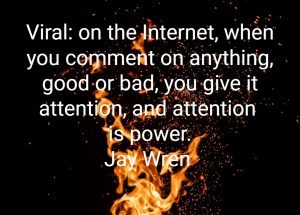
Viral: on the Internet, when you comment on anything, good or bad, you give it attention, and attention is power. ~ Jay Wren


Photo by Tobias Rademacher on Unsplash

Published
Categorized as Success

Guilt – A Painful Waste of Time

To be resilient, we must be able to forgive ourselves about our mistakes. Carrying around guilt lowers our self-esteem and confidence. Guilt does not help us correct mistakes. It only makes it more difficult to repair to damaged relationships.

So, let go of guilt. If you made a mistake, do not repeat it. If you did not make a mistake, just forget about what happened. If the guilt continues to plague you, can write about your feelings.  Then make a list of good things you can do for other people and do those things.

Ironically, guilt is a form of self-consciousness.  People who feel guilty are focusing on how they feel about their mistakes. To remove guilt focus on solutions to help other people.

Photo by Polina Kuzovkova on Unsplash

Published
Categorized as Success

Pause

When I feel frustrated, in doubt, or angry, stepping away from a situation gives me the opportunity to calm my emotions. The separation allows me to reduce the noise in my head. I think more clearly. I make better decisions. I can try to reduce tension between another person and me by saying things like this:

“May I get back to you?”
“If I were in your shoes, I might feel the same way.”
“I understand.”

But first, I must pause.

Photo by Isham Fernandez on Unsplash