Dramatic Hiring Trends that You Must Know About

Hiring in 2025 is being shaped by several key trends, reflecting rapid technological advancements and evolving workplace priorities. Here’s a breakdown of what’s trending:

Focus on Vocational Skills: The emphasis is shifting from traditional qualifications like degrees to what candidates can actually do. Skill-based hiring is becoming a primary focus. Companies are developing competency frameworks to assess essential skills for each role.

AI-Powered Recruitment: Artificial intelligence continues to revolutionize the hiring process. AI tools are being used to automate tasks like resume screening, scheduling interviews, and even improving candidate matching. However, there’s a growing understanding that AI is not a complete solution and requires strategic integration and human oversight to avoid biases and maintain a personal touch.

Employee Advocacy: A company’s reputation is increasingly important to job seekers. Employee advocacy, where current employees promote the company, is becoming a powerful tool for attracting talent. Candidates prioritize brand trust, making it crucial for companies to build a positive reputation.

Click Here.

Key Hiring Trends:

Flexibility is Key: Job seekers highly value flexible work arrangements, including hybrid and remote options. Companies offering such flexibility are better positioned to attract and retain top talent.

Rise of Recruitment Chatbots: Chatbots are being implemented to enhance communication with candidates, answer their queries, and improve the overall candidate experience.

Mobile-First Recruitment: Acknowledging that many job seekers use mobile devices, companies are optimizing their recruitment processes for mobile platforms.

Putting Job Seekers First: There’s a growing emphasis on improving the candidate journey, making the hiring process more transparent, engaging, and positive.

Internal Mobility: Companies are increasingly looking within their own ranks to fill open positions. Strong internal mobility programs are linked to higher employee engagement and retention.

Emphasis on Employee Value Proposition (EVP): Companies are focusing on clearly communicating what makes them a great place to work, going beyond basic perks to highlight values and a supportive work environment.

Quality of Hire: With AI potentially automating some tasks, recruiters are focusing more on strategic roles, including building relationships with candidates and ensuring a high quality of hire.

In-Demand Skills for 2025: Both technical and soft skills are highly sought after.

Technical Skills:
  1. Data Science and Analytics: With the increasing reliance on data-driven decision-making, skills in data analysis, visualization, extraction, engineering, processing, and mining are crucial.
  2. Artificial Intelligence (AI) and Machine Learning: Proficiency in AI, including prompt engineering and generative AI modeling, is becoming increasingly essential across various roles.
  3. Software Development and Programming: Skills in various programming languages (e.g., Python, Java, SQL), web development, and app development remain in high demand.
  4. Cybersecurity: With growing concerns about data security, cybersecurity skills are critical. Cloud Computing: Expertise in cloud platforms and technologies is highly valued.
  5. Digital Literacy: Basic digital skills are increasingly important for most roles.
Soft Skills – Traits:
  1. Analytical Thinking: The ability to critically analyze information and solve problems is consistently ranked as a top in-demand skill.
  2. Creativity and Proactivity: Thinking outside the box and generating innovative solutions are highly valued.
  3. Problem-Solving: Identifying and resolving complex issues effectively.
  4. Emotional Intelligence: Understanding and managing one’s own emotions and understanding the emotions of others.
  5. Leadership and Management: Guiding and inspiring teams effectively.
  6. Adaptability and Flexibility: Adjusting to changing circumstances and new challenges.
  7. Communication (Advanced): Both written and verbal communication, including active listening and negotiation.
  8. Resilience, Flexibility, and Agility: Bouncing back from setbacks and adapting to new situations quickly.
  9. Curiosity and Lifelong Learning: A willingness to learn and stay updated with new developments.
  10. Collaboration and Teamwork: Working effectively with others to achieve common goals.

Emerging Job Markets and Roles

Several sectors and roles are experiencing significant growth.

Technology: AI and Machine Learning Specialists, Big Data Specialists,
Fintech Engineers, Software and Application Developers, Cybersecurity Engineers, Data Scientists and Analysts, Cloud Engineers

Green Economy/Sustainability: Sustainability Specialists, Environmental and Renewable Energy Engineers, Autonomous and Electric Vehicle Specialists, Wind Turbine Service Technicians, Solar Photovoltaic Installers

Human Care Economy: Nursing Professionals, Social Work and Counseling Professionals, Personal Care Aides

Education: Tertiary and Secondary Education Teachers

Frontline Roles (in absolute volume): Farmworkers, Delivery Drivers, Construction Workers, Salespersons, Food Processing Workers.

Business and Finance: Business Intelligence Developers, Private Equity Analysts, Financial Analysts

Healthcare: Nurse Practitioners, Physician Assistants, Medical and Health Services Managers.

Declining Job Roles (in absolute numbers):

Clerical and Secretarial Workers (including Cashiers and Ticket Clerks, Administrative Assistants, and Executive Secretaries)
Postal Service Clerks
Bank Tellers
Data Entry Clerks
Printing Workers
Accountants and Auditors (due to automation)

In Conclusion

Overall, the hiring landscape in 2025 is dynamic, with a strong emphasis on skills, technology integration, and creating a positive and inclusive experience for candidates and employees alike. Organizations that adapt to these trends will be better positioned to attract and retain the talent they need to succeed.


The Nation’s Largest Brick-and-Mortar Retailers

Here are some of the nation’s largest brick-and-mortar retailers in the United States, generally ranked by revenue:

Walmart: Consistently holds the top position with the highest revenue and a vast network of stores across the country. They offer a wide variety of products, from groceries to electronics and apparel.

Costco Wholesale: A membership-based warehouse club known for its bulk goods and discounted prices. They have a strong and loyal customer base.
The Home Depot: The leading home improvement retailer in the U.S., with a large number of stores catering to both DIY enthusiasts and professional contractors.

The Kroger Company: One of the largest supermarket chains, operating under various banners across numerous states, providing groceries, pharmacy services, and more.

Walgreens Boots Alliance: A major pharmacy chain with a significant brick-and-mortar presence, offering prescription drugs, health and wellness products, and convenience items.

Target: Known for its trendy and affordable merchandise, spanning fashion, home decor, and electronics. They have a strong brand and a loyal customer following.

CVS Health Corporation: Another leading pharmacy and health services provider with a large number of retail locations.

Lowe’s Companies: The second-largest home improvement retailer, competing closely with The Home Depot.

Albertsons Companies: A significant supermarket chain with various store formats across the U.S.

Dollar General: A discount retailer with a large number of stores, focusing on affordable everyday essentials.

Key Characteristics of These Retailers:

    1. Extensive Store Networks: They operate thousands of physical locations across the United States, ensuring accessibility for a large portion of the population.
    2. High Revenue: Their large scale of operations translates to billions of dollars in annual revenue.
    3. Diverse Product Offerings: Most of these retailers offer a wide range of products to cater to various consumer needs.
    4. Omnichannel Presence: While primarily brick-and-mortar, most have also developed significant online and e-commerce capabilities to meet evolving consumer shopping habits.
    5. Adaptation to Change: These large retailers continuously adapt to changing consumer preferences, technological advancements, and economic conditions.

It’s important to note that rankings can sometimes vary slightly depending on the specific metrics used (e.g., revenue, market capitalization) and the reporting period. However, the companies listed above consistently appear among the largest brick-and-mortar retailers in the United States.

Sources and Related Content

Source iconTop 100 Retailers 2024 List | NRF – National Retail Federation

nrf.com

Opens in a new window

Source iconWalmart | Save Money. Live better.

walmart.com

Opens in a new window

Source iconCompany Information – Costco Wholesale

www.costco.com

Opens in a new window

Source iconUnlocking Costco’s Secret Sauce: What Drives Its Record-breaking Profits And Valuation?

www.my.publicpower.org

Opens in a new window

Source iconAbout Us | The Home Depot

corporate.homedepot.com

Opens in a new window

Source iconOur Business – The Kroger Co.

www.thekrogerco.com

Opens in a new window

Source iconWalgreens Boots Alliance

www.boots-uk.com

Opens in a new window

Source iconCVS Health – Wikipedia

en.wikipedia.org

Opens in a new window

Source iconAlbertsons Companies, Inc. – Home

albertsonscompanies.com

Opens in a new window

Source iconDollar General – Wikipedia

en.wikipedia.org

Emotional Intelligence: 12 Steps to Empowering Your Mind

Emotional Intelligence:  Learning how to manage emotions is part of growing up. However, becoming aware that our feelings are making us dumber is not always easy. How do successful people deal with emotions to make better decisions?

Developing Emotional Intelligence

Although it is normal to have emotional highs and lows, successful people separate their emotions from their thinking to make the best decisions.

For example, things look easier and more appealing when we are on an emotional high. With these feelings, we may overcommit our time and money.

On the other hand, things look more difficult and unpleasant when we are feeling down. Emotional lows can prevent us from working well with others. Furthermore, when emotional lows shut us down, we can fail to take advantage of opportunities all around us. Our coping skills become less effective. Our relationships with others become more difficult.

Here are twelve steps that may help.

Live in the present moment

Get out of our head. Focus on what is in front of us and around us. This focus enables us to make good decisions and take the best actions. Leaders live in the world around them and not in the crumbling castles in their head.

Let go of Resentments

Ruminating on past wrongs drains our energy. Furthermore, holding on to resentments create a permanent state of anger.

This anger clutters our mind. Decisions become more difficult. Patience and compassion disappear. We either act out our anger or become passive aggressive.

Let go of guilt

Carrying around guilt lowers our self-esteem confidence. There are only two things you can say about guilt. Either you were wrong and you will try not to do it again. Or you were not wrong. Therefore, you are not going to worry about it.

Let go of fear

Fearing the future creates clutter in our mind and weakens our imagination. Many of the things we fear never happen.

Solutions:  When we are feel resentful, guilty or afraid I take a deep breath. I step away and take a break. Often either exercise or rest help me move beyond these feelings.

Make new mistakes

Everyone makes mistakes. Smart people only make a mistake once.

Mistake made.
Lesson learned.
Moved on.

Furthermore, if you never make any mistakes, you have settled in to trod the path paved for you. You are doing nothing new. Creativity dies. Growth stops. Your career has high walls on either side. When you reach a cliff in your career, you can’t go further.

Allow yourself opportunities to try to new things. Furthermore, do not punish yourself for being less than perfect.

Focus on the process not the goal

Create the goal. Create a plan to reach your goal. Continually update the plan.

However, the way that things turn out is beyond our control.

For example, a retail goal is to make sales. A store can plan to increases its sales when it increases the number of shoppers in the store and the amount of time each shopper spends in the store. Retail stores focus on the process of getting and keeping shoppers in their stores.

Measure results, adjust, and move on

Even with a perfect process, stores may miss their sales goals. Many things are beyond anyone’s control:  the weather, a catastrophic event, a sudden shift in the economy.

Don’t make excuses for missing goals

However, adjust and learn from the experience. If the weather or a catastrophic event weakens a store’s sales, the store can stay open longer hours when things return to normal. If the economy is weak, stores can carry a wider assortment of less expensive products. Stores can change their process.

Practice, practice, practice, and continue to practice

From practice comes powerful instincts and heightened intuition. Companies teach people and show these people how to practice and improve their skills. Employees practice new skills. Furthermore, through practice, they increase their ability to use the skills they already have. Great performers and athletes practice before, during, and after practice.

The purpose of practice is to raise a skill level. Yet what really happens is that practice creates instincts and intuition to work at a higher level under pressure. As your skill level rises, you feel less stress. You perform better and have more confidence.

Embrace consistency and assess change

One of the business clichés is to embrace change. Sometimes change is good. Sometimes change is way to get lost in the wilderness.

Change can create many feelings. Positive change lifts our spirit. Negative or uncertain change is stressful.

One solution is to assess the value of changes. From there, focus your attention and your effort on positive change. However, don’t focus on the prospects of change. Remember, we can’t control the future.

Leaders value relationships as much as they value tangible assets.

It is a lot easier to lose a client than to get one. Pleasing other people may sound shallow, but pleasing other people is the reason for repeat business.

Limit your daily activities

Leaders set priorities based on the things they can get done today. This process removes anxiety over things beyond their control. Focusing on today’s priorities empowers the leaders to follow the process from their plan.

Hang out with winners

I need advice from real humans. It is so easy for me to believe my thinking, because I have always heard it. When I isolate, I become inefficient. I spend too much time at my desk. I overlook deadlines and let important matters go unattended.

Photo by Luke Chesser on Unsplash

Words that Empower and Motivate Successful Teams

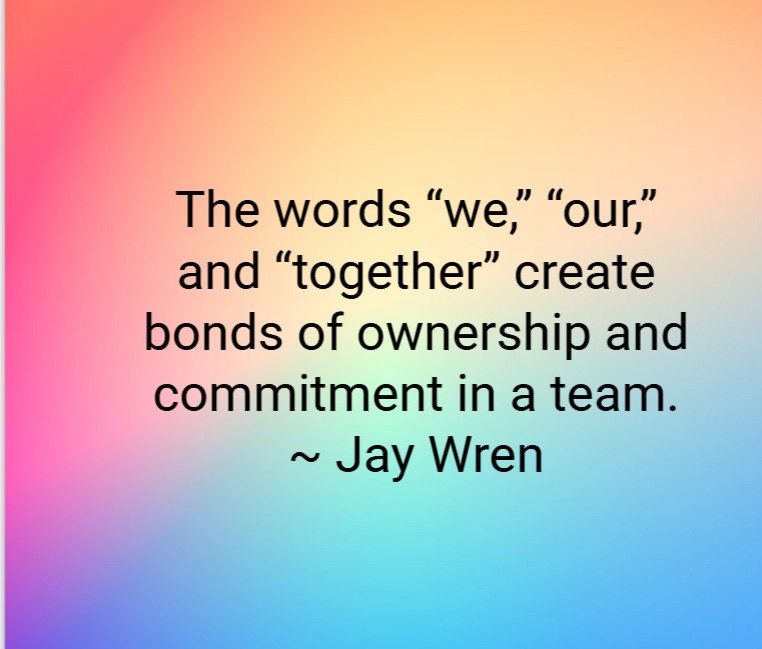
The words “we,” “our,” and “together” create bonds of ownership and commitment in a team. ~ Jay Wren

Successful Teams: Words that empower and motivate teams create bonds among the team members. These words acknowledge ownership of responsibility. Furthermore, they show recognition of team member contributions. What are some of these words?

Categories for Words that Motivate Successful Teams

Here are four categories for words that help teams become more successful.

  1. Inclusiveness
  2. Ownership
  3. Recognition
  4. Honesty

Inclusiveness

The words “we,” “our,” and “together” create bonds of ownership in a team.

Additionally, calling people by their name increases bonds.

For example, picture this presentation. A team leader is recognizing a team’s efforts in front of other people in the company.

The presentation of the team leader might go like this.

“Bill and Sue are new members on our team. Together, our team has finished ahead of schedule and below cost. Furthermore, we have exceeded our team goals.” ~jaywren.com

Ownership

Accepting responsibility for mistakes is an important trait for members of a team. These are examples of ownership statements.

“I regret my mistake.” “I accept responsibility for the things I could have done better.” “I can and will do better.”

Recognition

Award ceremonies serve several purposes. One is to make people feel good about their work. A second, is to motivate people through recognition.

However, team leaders don’t need to wait for an award ceremony to give credit. Here are words to recognize contribution.

“You did a good job.” “Thank you.” “I would not have expected less from you.”

Honesty

Nice words are not enough to empower teams. The members need honesty. When they make mistakes, team leaders must help them see those mistakes.

Misleading team members damages the team’s effort.

People who are defensive about their mistakes lack self-honesty. Insecurities cripple their ability to bond with a team. Rather than accept responsibility and correct their mistakes, these people become a burden to the team.

Here are some ideas for dealing with people who struggle with self-honesty.

Criticism of these people makes them feel more insecure. They become more defensive.

Team leaders can help defensive people become more effective team members by teaching them that taking ownership for their mistakes builds trust.

Additionally, team leaders can teach these people that most people make mistakes. However, denying mistakes or repeating mistakes makes these team members ineffective.

Team leaders can teach people how to own their mistakes with the words they choose. For example, “I was wrong. I made a mistake and will try not to make it again.”


Published
Categorized as Leadership

Solutions: How Successful People See the World

Solutions: Viewing the world as a series of problems is discouraging, even scary. How can we change our outlook for greater success?

People who see solutions do not view the world as a series of problems. ~ www.jaywren.com

My Story

When I was a Navy bridge officer on a carrier, I had a commanding officer who required that all the bridge officers recognize the times when we needed to let him know about a problem. Sometimes, urgency required that we tell him before we had a solution. However, he also demanded that we bridge officers give him a solution when we could develop one. Furthermore, he asked that we give him more than one solution. He asked if we give him options.

His requirements for dealing with problems taught us to see more than the problems we met. We learned to think tactically. We developed skills to find solutions. This growth experience in problem solving prepared us to manage greater responsibility.

Perspective

Recognizing problems when they are real is a practical view of the world. Acting to solve problems is also practical. This action reduces our anxiety and clears our mind to make better decisions.

Resources

In many cases, we have what we need to deal with problems, if in fact, they ever happen. For example, there are solutions to reducing stage fright. When we fear speaking in front of other people, we are focusing on how other people will judge us.

However, none of us can control how other people will judge us. On the other hand, what all of us can do is to stay in the present moment and prepare for interviews and presentations.  When we know our material, and when we can present it with confidence in front of a mirror, giving our presentation to an audience becomes easier.

Solutions

When we see a problem ahead, we should always tell our supervisor long before the problem happens. Doing so gives them the time to find solutions.

Furthermore, we should not wait to find a solution to every problem before notifying our supervisor.

However, we can let supervisors know that we are working on a solution or that we have a recommended solution.

Problem Solvers Gain Respect

People who live with a head full of anxiety lack confidence. Expressing anxiety to a supervisor or team members weakens the confidence that these people have in us.

However, people who show others have how to solve problems gain respect and emerge as leaders.

How to Motivate Yourself to Stand Up and Walk Around

Sitting for extended periods can really take a toll on our bodies and minds. Here are some tips to motivate yourself to stand up and walk around more:

  1. Set Reminders:
  • Technology is your friend: Use your phone or computer to set reminders to stand up and stretch every 30 minutes.
  • Sticky notes: Place them on your monitor, keyboard, or desk to remind you to move.
  • Movement apps: Explore apps that track your movement and encourage you to stand up more.
  1. Gamify It:
  • Step challenges: Compete with friends or colleagues to see who can take the most steps each day.
  • Movement goals: Set daily or weekly goals for steps taken and reward yourself for reaching them.
  • Turn walking into a game: Make it a fun challenge to reach a certain number of steps by lunchtime or by the end of the day.
  1. Make Movement More Appealing:
  • Find a walking buddy: Walking with a friend or colleague can make it more enjoyable and motivating.
  • Listen to podcasts or audiobooks: Make your walks more engaging by listening to something interesting.
  • Explore your surroundings: Take advantage of your walks to explore your neighborhood or workplace and discover new places.
  1. Create a Standing Workstation:
  • Invest in a standing desk converter: This allows you to easily adjust your desk height.
  • Use books or boxes to raise your monitor. This is a simple and affordable way to create a makeshift standing desk.
  1. Schedule Movement Breaks:
  • Walk during your lunch break. * Take short walking meetings.
  • Use the restroom on a different floor.
  1. Make it a Habit:
  • Start small and gradually increase your movement throughout the day.
  • Celebrate your successes and stay positive.

Remember, consistency is key! Even small changes in your routine can make a big difference in your overall health and well-being.

If you’d like, tell me about a specific challenge you’re facing in getting yourself to move more, and I can give you some more tailored advice.

If You Can Keep Your Head When All About You Are Losing Theirs


Ultimately, Kipling suggests that embodying these traits leads not just to success but to the fulfillment of one’s potential as a human being. This poem resonates across generations because of its universal lessons on character and strength.

“If you can keep your head when all about you
Are losing theirs and blaming it on you,
If you can trust yourself when all men doubt you,
But make allowance for their doubting too;

If you can wait and not be tired by waiting,
Or being lied about, don’t deal in lies,
Or being hated, don’t give way to hating,
And yet don’t look too good, nor talk too wise

If you can dream – and not make dreams your master;
If you can think – and not make thoughts your aim;
If you can meet with Triumph and Disaster
And treat those two impostors just the same;

If you can bear to hear the truth you’ve spoken
Twisted by knaves to make a trap for fools,
Or watch the things you gave your life to, broken,
And stoop and build ’em up with worn-out tools

If you can make one heap of all your winnings
And risk it on one turn of pitch-and-toss,
And lose, and start again at your beginnings
And never breathe a word about your loss;

If you can force your heart and nerve and sinew
To serve your turn long after they are gone,
And so hold on when there is nothing in you
Except the will which says to them: ‘Hold on!’

If you can talk with crowds and keep your virtue,
Or walk with Kings – nor lose the common touch,
If neither foes nor loving friends can hurt you,
If all men count with you, but none too much;

If you can fill the unforgiving minute
With sixty seconds’ worth of distance run,
Yours is the Earth and everything that’s in it,
And – which is more – you’ll be a Man, my son!”
― Rudyard Kipling, If: A Father’s Advice to His Son

Courage to Continue

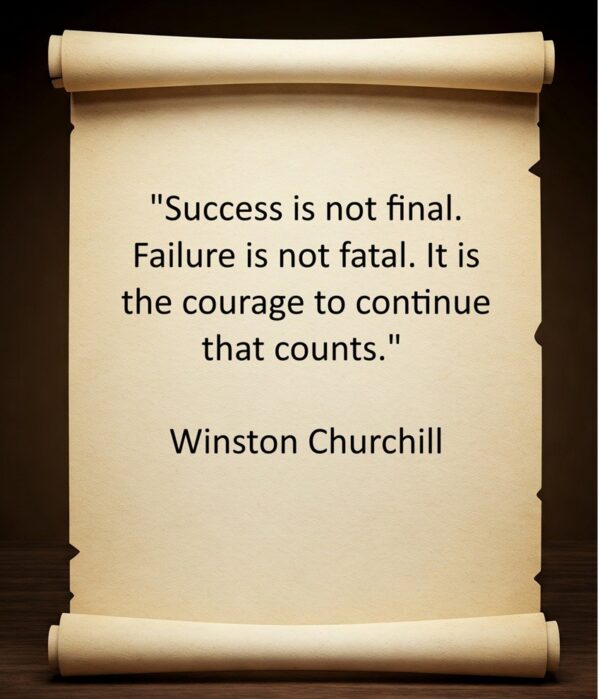
“Success is not final, failure is not fatal: it is the courage to continue that counts.”  Winston Churchill

Success is not final.

Even repeating our actions does not guarantee success. As our circumstances change, the actions we need for success change. For nearly thirty years, I built a recruiting business based on using a telephone, a database of file cards, and paper mail.  Over time, the need for a telephone shriveled to a small part of my business communications, my database went from file cards to my computer, and emails have all but replaced postal mail.

Failure is not fatal.

Over all the years of recruiting, I had many failures. I had candidates turn down offers. I lost clients through company mergers, acquisitions, and changes in recruiting practices. I had to learn that my business was a numbers game. The number of contacts I reached determined how much money I made. Everyone has failures. Focusing on my failures would only create more failures and eventually kill my business. Focusing on the numbers of contacts I made and not the failures I encountered, I moved through decades of change successfully.

During a period of frustration, I called a friend and told him of my fears that my business might fail. He suggested that I just think about what was on my desk, act on those things, and let the results take care of themselves.  I had to learn that success was not a matter of thinking, but a matter of planning and acting.

I called a partner one time and told him that I had a problem.

I began by saying,” I was just thinking.”

He cut me off. He said, “That statement explains your problem. You have to stop thinking and start acting.”

Planning has its place as a form of action but not as a form of painful mental processing.

It is the courage to continue that counts.

Finding courage is an inside job. Ruminating produces worrying. Here are some things that help me stop ruminating and find courage.

  1. Eating when I am hungry
  2. Resting when I am tired
  3. Stopping to help other people
  4. Meditating to rest my mind
  5. Turning anger into an opportunity to take a walk

I am not perfect. I still become overconfident when I am successful. When I experience failure, I become frustrated, angry, and fearful. I sometimes lack courage to face problems. However, when I allow myself to get back into action and to live a healthy life, I find the courage to accept failure and find new ways for success.


Eating Healthy Foods while Beating Inflation

I am not a nutritionist. I worked in grocery stores while I was in college. I also recruited for food manufacturers over 30 years. Consequently, I have spent decades reading about and working in the food industry.

Inflation and Food

Inflation has been a hot topic, especially when it comes to food prices. While many staples have seen significant price hikes, some foods have managed to remain relatively stable. Check prices and do your own research. I pick these inflation-resistant foods. They might be your best bet for budget-friendly meals.

Foods That Defy Inflation

1. Root Vegetables
Potatoes, carrots, and onions are not only versatile but also tend to have stable prices. Their long shelf life and ease of storage make them less susceptible to supply chain disruptions.

2. Legumes and Pulses
Lentils, chickpeas, and beans are pantry staples that offer high nutritional value at a low cost. Their dried form, in particular, is incredibly economical and unaffected by inflationary pressures.

3. Rice and Oats
These grains are global staples with consistent production levels, making them less prone to price fluctuations. They’re also incredibly versatile for meals.

4. Seasonal Produce
Buying fruits and vegetables that are in season locally can help you avoid the inflated costs of imported or out-of-season items.

5. Protein
For vegans, inflation is less of a problem, at least for now. Eggs are currently the hardest hit protein source. Some options that work for me are whole chicken, seafood, and less expensive cuts of beef and pork.

6. Canned Goods
The stability of can goods comes down to their production and storage characteristics. Foods with long shelf lives, high yields, or local availability are less affected by global supply chain issues and transportation costs. Additionally, items that don’t rely heavily on imported ingredients or specialized farming conditions tend to be more resilient.

Tips for Budget-Friendly Shopping

– Buy in Bulk: Stock up on non-perishable items like rice, oats, and canned goods when they’re on sale.
– Cook at Home: Preparing meals from scratch can save money and allow you to make the most of affordable ingredients.
– Plan Meals Around Sales: Check weekly grocery store flyers for deals on seasonal produce and other staples.

By focusing on these inflation-resistant foods, I have more success in keeping my grocery bills in check without compromising on nutrition or variety.